To access our site, you must confirm that you are at least 18 years old.
At MushVerse, we use first-party and third-party cookies to enhance the user experience on our website by analyzing traffic and improving content. Technical cookies are necessary for basic functionality and are always active. For more information, you can consult our privacy policy.
In just a few decades, psilocybin has gone from being a marginal topic to becoming an object of scientific, therapeutic, and cultural study. Yet online, information tends to be fragmented, repetitive, or simply wrong. This list brings together the books that, together, form a solid foundation for understanding the phenomenon from every angle: where its use comes from, how it works in the body and brain, how the mushrooms are identified and cultivated, how to use them responsibly, and what cultural and philosophical reflection they have generated.
This isn't a list meant only for academic readers. It's useful whether you're just starting to take an interest in the topic, want to grow your own, are looking to use them mindfully, or simply want to understand the historical and cultural context behind these mushrooms.
One note before diving in: most of these titles are written from a Western academic or countercultural perspective. That's why the History section also includes the direct testimony of María Sabina, the Mazatec healer whose ritual knowledge gave rise to this entire field of study, and why critical nuances are flagged where relevant.
Titles appear translated when an official edition exists in your language. When it doesn't, the original title is kept so you can find it precisely if you decide to look it up.
History of psychedelics and the origins of ethnomycology
Before getting into science or cultivation, it helps to understand where all of this comes from. These books explain how humans came to discover, use, and eventually study these mushrooms, without losing sight of the tension between those who lived the tradition and those who documented it from the outside.
The General History of Drugs, by Antonio Escohotado. An encyclopedic survey of the role psychoactive substances have played throughout human history, with the legal, social, and political context needed to place psilocybin within a wider frame.
María Sabina: Her Life and Chants, by Álvaro Estrada. This is the transcription and direct testimony of María Sabina, the Mazatec healer whose knowledge of the mushroom ritual was the starting point for all of modern ethnomycological research. Unlike the books by Wasson or McKenna, here the central voice belongs to the person who originally held the knowledge, not the researcher who documented it.
Soma: Divine Mushroom of Immortality, by Robert Gordon Wasson. Although this book focuses on Amanita muscaria rather than psilocybin, it's a foundational work because it marked the birth of the modern ethnomycological field. Without Wasson, much of the research that followed wouldn't exist, though it's worth reading with a critical eye: his 1957 Life Magazine article popularized Huautla de Jiménez and triggered a wave of psychedelic tourism with documented negative consequences for the Mazatec community, something María Sabina herself came to publicly regret.
The Road to Eleusis, by Wasson, Hofmann, and Ruck. Explores the role of psychoactive substances in the Eleusinian Mysteries of ancient Greece, and helps show that the ritual use of plants and mushrooms with psychedelic effects is neither a recent nor a marginal phenomenon, but a constant across different civilizations.
Identifying psilocybin mushrooms, science, and fungal botany
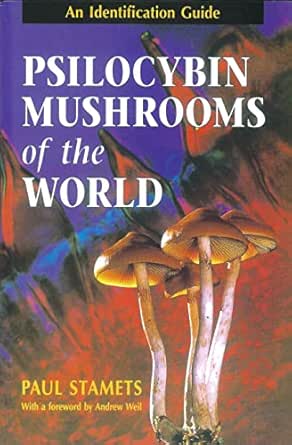
Paul Stamets's botanical identification guide, one of the reference books on this list.
Once the historical context is in place, this section covers the biological and scientific foundation: what these mushrooms are, how to recognize them, and what we know about their chemistry.
Psilocybin Mushrooms of the World: An Identification Guide, by Paul Stamets. The definitive reference for identifying species, with detailed descriptions and photographs. It also includes geographic distribution maps, morphological identification keys, and warnings about toxic lookalike species, such as Galerina.
Pharmacotheon, by Jonathan Ott. A rigorous, dense analysis of the pharmacology of psychoactive plants and mushrooms, with particular attention to psilocybin. It's essentially the technical bible for understanding alkaloids, exact dosages documented in the scientific literature, and historical preparation methods from a hard-chemistry perspective.
Entangled Life, by Merlin Sheldrake. While not focused exclusively on psilocybin, it offers a fascinating look at the fungal kingdom as a whole, and helps explain why mushrooms are such singular organisms from a biological standpoint.
Books and manuals for growing psilocybin mushrooms at home
For anyone ready to move from theory to practice, these two books are the standard reference for mushroom cultivation.
The Mushroom Cultivator: A Practical Guide to Growing Mushrooms at Home, by Paul Stamets and J.S. Chilton. The definitive technical manual for growing mushrooms at home, with detailed step-by-step processes. Focused on classic laboratory mycology: from preparing agar Petri dishes and isolating strains to grain sterilization and bulk substrate fruiting.
The Psilocybin Mushroom Bible, by Mandrake and Virginia Haze. Complements the previous title with a more modern, accessible approach, aimed at anyone looking for a complete cultivation process without needing advanced lab equipment.
Guides to responsible use, dosing, and therapy with psilocybin
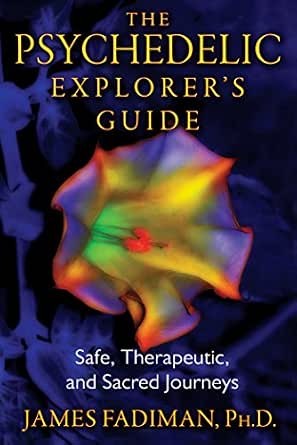
James Fadiman's classic manual on dosing, session protocols, and responsible use.
This section brings together the most practical books, aimed at anyone looking for concrete information on how to use psilocybin safely, mindfully, and with a clear understanding of what they're doing.
The Psychedelic Explorer's Guide, by James Fadiman. Arguably the reference book on dosing, protocols, and responsible use of psychedelic substances, including psilocybin. It pioneered the concept of the sitter, how to structure a session (music, environment, or setting), and established the modern microdosing protocol now known as the Fadiman method.
The Psilocybin Handbook for Women, by Jennifer Chesak. Offers a perspective specifically on use in women, covering aspects that other general manuals don't, such as how psilocybin interacts with the menstrual cycle, menopause, endometriosis, or premenstrual syndrome, as well as the gender gap that has historically existed in clinical trials.
Your Psilocybin Mushroom Companion, by Michelle Janikian. An accessible, straightforward guide for anyone approaching the topic for the first time who wants to be well informed before experimenting.
How to Change Your Mind, by Michael Pollan. The book that introduced much of the general public to the scientific renaissance of psychedelic research, with particular attention to recent clinical studies on psilocybin.
Philosophy and the psychedelic vision
This section moves a bit away from the purely practical to enter the territory of reflection, speculation, and subjective experience, even though some of its titles combine that outlook with a strong technical and chemical component.
Food of the Gods, by Terence McKenna. McKenna's best-known and most debated hypothesis about the role psilocybin mushrooms played in the evolution of human consciousness.
The Archaic Revival, by Terence McKenna. Continues the philosophical and cultural reflection on the role of psychedelics in contemporary society.
TiHKAL: The Continuation, by Alexander and Ann Shulgin. Centered on tryptamines, it includes psilocin, which earns it a place on this list. It combines autobiographical narrative with chemical detail and is a key work for understanding the chemistry behind the experience.
Niche reading on psilocybin and ethnomycology
This section is optional and aimed at anyone who wants to go beyond the essentials. These aren't general recommendations, but niche gems, archival pieces, or hyper-specific texts that an advanced reader will appreciate.
The Entheogen Review Complete (1992-2008). A collection that's hard to find in physical form and dense to read, but with enormous historical and documentary value for anyone who wants to dig deeper into the study of entheogens from an almost archival perspective.
The Mushroom in Christian Art, by John A. Rush. An extreme and controversial academic work exploring the hypothesis that psilocybin mushrooms and Amanita muscaria appear in Christian iconographic art, from frescoes to medieval manuscripts. A fascinating read for anyone interested in art history, comparative religion, and hidden symbolism.
The Sacred Mushroom and the Cross, by John M. Allegro. The classic "forbidden book" of ethnomycology. Allegro, a philologist who worked on translating the Dead Sea Scrolls, argued that early Christianity originated from a secret mushroom cult, a thesis that cost him his academic career. This isn't a book about psilocybin in any practical sense, but a cult text on philology, ancient linguistics, and fungal mythology.
Growing Gourmet and Medicinal Mushrooms, by Paul Stamets. An excellent cultivation manual focused on edible and medicinal species that aren't psilocybin mushrooms, such as reishi, lion's mane, or shiitake. Ideal for anyone who, after mastering home cultivation of psilocybin mushrooms, wants to take their lab technique to the next level and grow other fungal species at home.
Which book to choose based on your profile: beginner, grower, or researcher
Nobody needs all sixteen books at once. Depending on your profile, you can start with a smaller core:
If you're a beginner who wants to understand the phenomenon overall: How to Change Your Mind, Food of the Gods, Your Psilocybin Mushroom Companion.
If you want to grow your own: The Mushroom Cultivator and The Psilocybin Mushroom Bible.
If you're looking to use them mindfully and safely: The Psychedelic Explorer's Guide, The Psilocybin Handbook for Women, Your Psilocybin Mushroom Companion, How to Change Your Mind.
If you're interested in the science and identification: Psilocybin Mushrooms of the World, Pharmacotheon, Entangled Life.
If you want the historical context and cultural reflection: The General History of Drugs, María Sabina: Her Life and Chants, The Road to Eleusis, The Archaic Revival.
Reading as a map for exploring psilocybin
Learning about psilocybin isn't about memorizing botanical fact sheets or consuming literature out of pure theoretical curiosity. Each of these books offers a different lens for looking at the same phenomenon: the complex relationship between humanity and the fungal kingdom across the centuries.
If this bibliography proves anything, it's that knowledge isn't static. Someone who starts out looking for a technical cultivation guide often ends up fascinated by the underlying biology or ancient history; someone looking for therapeutic answers ends up understanding the importance of cultural context and careful preparation.
There's no rush to read them all. Pick the title that speaks to your current interest, approach the reading critically, and remember that in the fields of mycology and psychedelics, the best theory is always the one that fosters caution, respect, and rigor.